Military Ranks in Nigeria and Their Equivalents
The Nigerian Army, Navy, and Air Force make up the armed forces of Nigeria. They operate under a structured system of ranks that defines authority, command, and responsibilities. One unique thing about the military ranks in Nigeria is that they each have a ranking system, though they share similar hierarchical structures.
In this comprehensive guide, we’ll break down everything you need to know about their ranks and their equivalents, help you understand how each officer and soldier relates across services and joint operations.
Military Ranks In Nigeria
When it comes to the Nigerian military hierarchy, the ranks are subdivided into two main categories.
- The commissioned officers: The commissioned officers hold leadership positions and are responsible for strategic decision-making. They start their ranks from Second Lieutenant (or its equivalent) up to the General.
- Non-commissioned officers (NCOs): These are the backbone of the military, providing essential leadership at ground level. They rise through the ranks based on experience and performance.
RECOMMENDED==> Nigerian Army 90RRI Recruitment Form And Portal 2025/2026
N/B: For each service, the structure remains the same, just with different titles and insignia.
Commissioned Military Ranks in Nigeria and Their Equivalents
| Army | Navy | Air Force |
| Second Lieutenant | Midshipman | Pilot Officer |
| Lieutenant | Sub-Lieutenant | Flying Officer |
| Captain | Lieutenant | Flight Lieutenant |
| Major | Lieutenant Commander | Squadron Leader |
| Lieutenant Colonel | Commander | Wing Commander |
| Colonel | Captain | Group Captain |
| Brigadier General | Commodore | Air Commodore |
| Major General | Rear Admiral | Air Vice Marshal |
| Lieutenant General | Vice Admiral | Air Marshal |
| General | Admiral | Air Chief Marshal |
Roles of Non-Commissioned Officers
Privates and Recruits: This is where everyone begins their journey. Recruits undergo intensive training at the Nigerian Defense Academy or other military training institutions. After completing basic training, a recruit becomes a Private. This is the entry-level rank for enlisted personnel.
Corporals and Sergeants: Corporals often lead small teams and serve as the link between junior soldiers and higher-ranking NCOs. Sergeants, on the other hand, are experienced soldiers who supervise and train junior personnel. They play crucial roles in maintaining discipline and operational readiness.
Warrant Officers: The highest NCO rank, Warrant Officers are technical and tactical experts who advise commissioned officers.
ALSO READ==> Nigerian Navy DSSC Rank and Salary 2026
| Army | Navy | Air Force |
| Recruit | Trainee | Recruit |
| Private | Ordinary Rating | Aircraftman |
| Lance Corporal | Able Rating | Lance Corporal |
| Corporal | Leading Rating | Corporal |
| Sergeant | Petty Officer | Sergeant |
| Staff Sergeant | Chief Petty Officer | Flight Sergeant |
| Warrant Officer | Warrant Officer | Warrant Officer |
| Master Warrant Officer | Master Warrant Officer | Master Warrant Officer |
Highest Military Ranks in Nigeria
For each service, there is an equivalent rank of five stars, even though not all are currently active. These are the highest possible military ranks in the Nigerian armed forces:
- Army: General of the Army
- Navy: Admiral of the Fleet
- Air Force: Marshal of the Nigerian Air Force
The Importance of Rank Structure in Military Operations
The hierarchical structure represented by the military ranks in Nigeria is essential for effective military operations. With a clear chain of command, there is quick decision-making during critical situations, maintaining discipline, and establishing accountability.
In combat or emergencies, every soldier must know exactly who gives orders and who follows them; this clarity literally differentiates between life and death, success or failure.
The rank equivalence ensures coordination during joint military operations. Peacekeeping missions or national emergencies. A lieutenant commander in the Navy has the same authority as a squadron leader in the Air Force and that of a major in the Army. This structure, over time, has helped to maintain discipline, respect, and unity amongst all branches of the military in Nigeria.
ALSO READ==> The Nigerian Navy Batch 39 recruitment Form/Portal 2026/2027
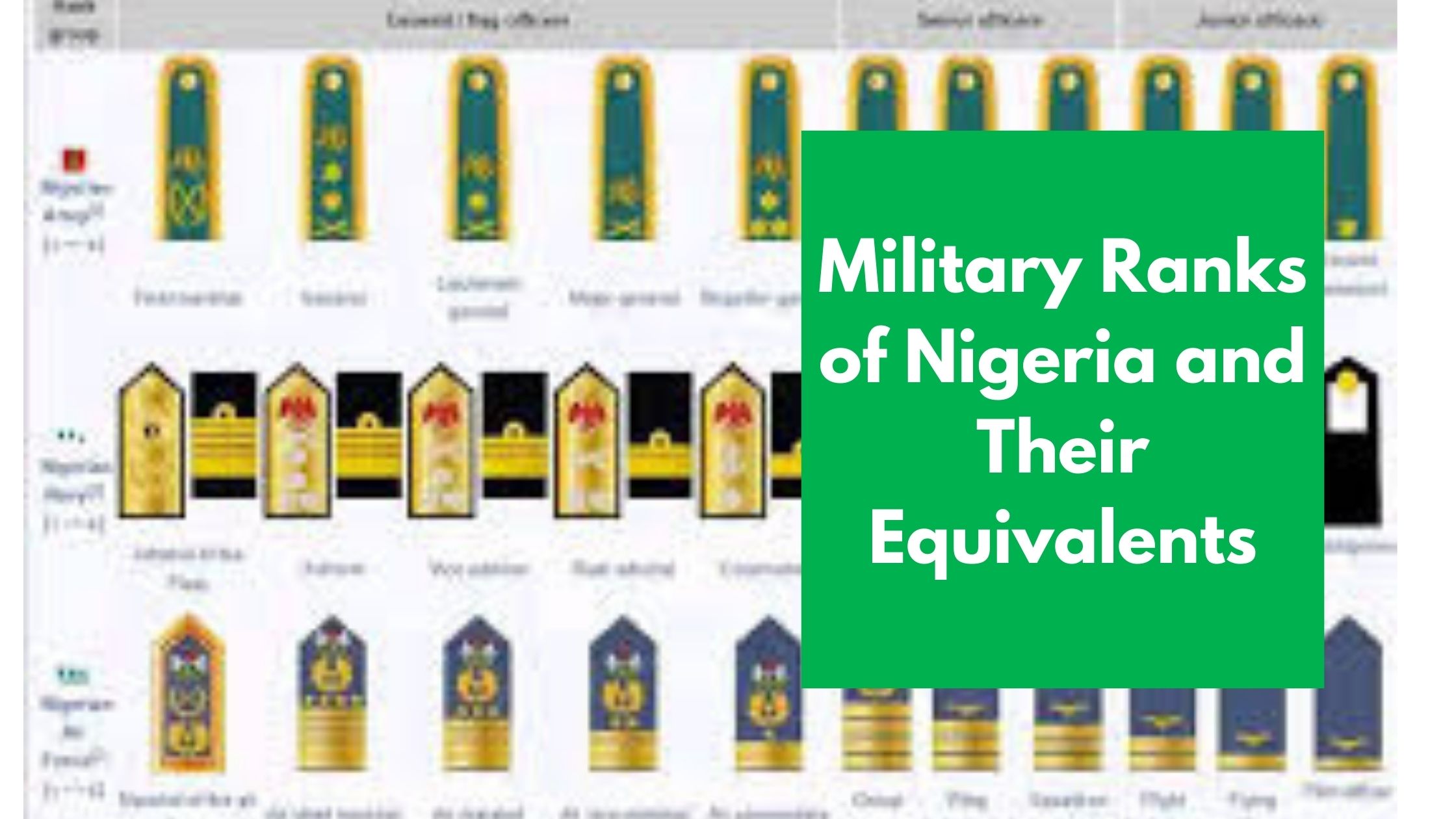
Military Rank Symbols and Insignia
As titles differ in the military, so do insignia. Across services, the insignia follows a pattern based on stars, swords, eagles, and anchors;
Army: The Nigerian army uses stars, swords, and the Nigerian eagle for its representations and identifications
Navy: The Navy uses stars, anchors, and eagles for its representation, often on the shoulder boards or sleeves.
Air Force: The Air Force uses eagles and stars, with distinctive blue and gold designs
The seniority in ranks is often represented by the number of stars; for instance, a brigadier general has one star, while a major general has two stars.
Conclusion
The Nigerian military ranks and their equivalents reflect the discipline, hierarchy, and structure that hold the Armed Forces together. Each rank carries its own responsibilities, challenges, and opportunities to make a difference.
If you’re considering joining the military, start preparing now—focus on your education, maintain physical fitness, and stay informed about recruitment opportunities through official channels like the Nigerian Defence Headquarters website and authorized recruitment portals.
Remember, whether you’re aiming to become a General or start as a recruit, every rank in the Nigerian military plays a vital role in defending our great nation. Understanding this structure is the first step toward appreciating the dedication and sacrifice of those who serve in uniform.